The short version
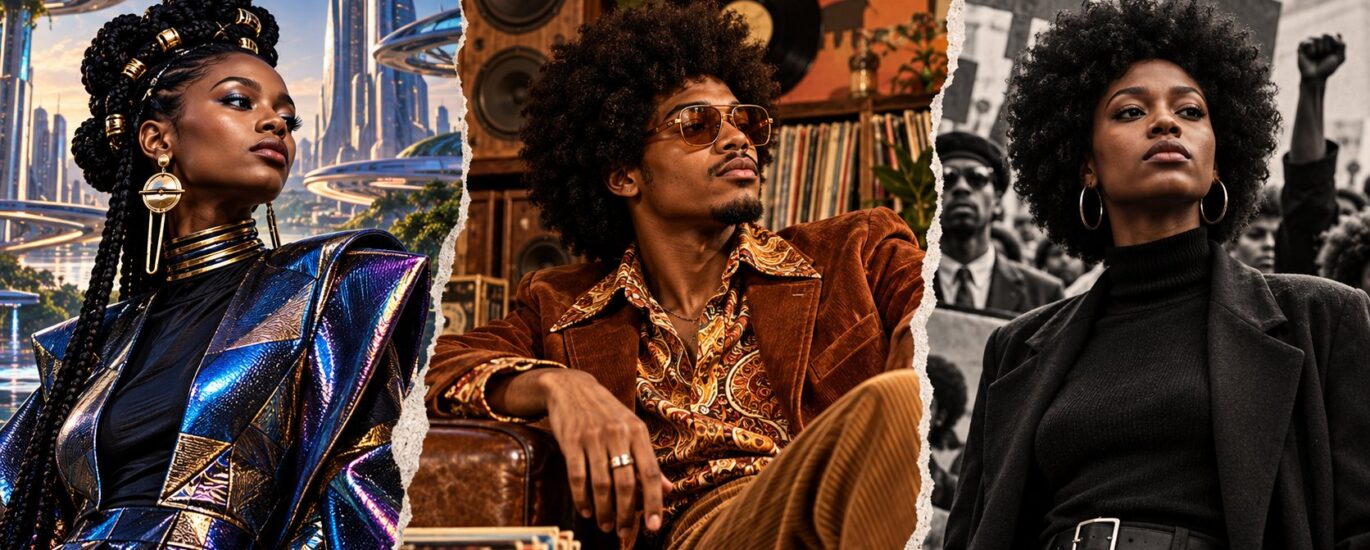
Afrofuturism imagines the future, retro soul celebrates the 1970s, and movement-era style honors the organizing of the 1960s. All three are among the strongest visual languages in culture apparel. Afrofuturism uses space, science and symbols. Retro soul uses halftone portraits, warm color and vintage type. Movement-era style uses documentary photography, bold type and comic-panel energy.
The three aesthetics compared
| Afrofuturism | Retro soul | Movement era | |
|---|---|---|---|
| Looks toward | The future | The 1970s | The 1960s |
| Core idea | Who gets to own the future | Joy, glamour, sound | Organizing, self-determination |
| Visual language | Galaxies, DNA, sacred geometry, circuitry | Halftone portraits, warm tones, script type | Documentary photos, bold block type, comic panels |
| Key music | Sun Ra, Parliament, Janelle Monáe | Soul, funk, disco | Gospel, protest songs, early funk |
| Key film | Space Is the Place (1974) | 1970s soul and variety TV | Judas and the Black Messiah (2021) |
| Key book | Parable of the Sower (1993) | Music memoirs and liner notes | The Autobiography of Malcolm X (1965) |
What is Afrofuturism?
AFROFUTURISM
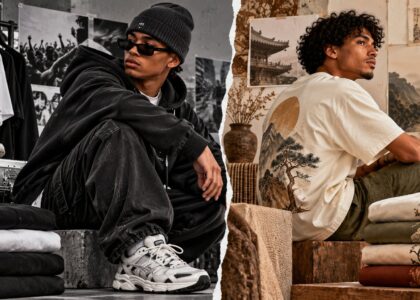
Afrofuturism is an artistic movement that uses science fiction, technology and myth to imagine futures centered on the African diaspora. The critic Mark Dery coined the term in 1993, but the tradition is older: Sun Ra was performing as a cosmic traveler in the 1950s, and Parliament landed the Mothership in 1975. In clothing, Afrofuturism shows up as galaxies, DNA, geometry and ancestral symbols rendered with a futuristic edge.
What is retro soul style?
RETRO SOUL
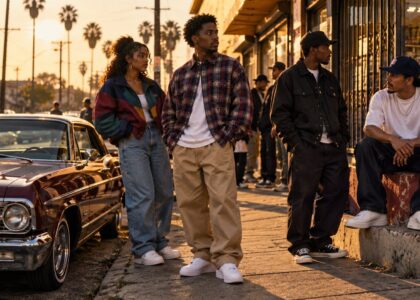
Retro soul style draws on the look of 1970s soul music and television: big hair, wide collars, halftone portraits, gold accents and warm color. It’s the era when Soul Train, taped in Los Angeles from 1971, broadcast Black music, dance and fashion to the whole country every week. In clothing, retro soul means vintage-feeling portraits, script lettering and colors that look like an album sleeve.
- Wear it: High Frequency Tee brings the gold-and-purple palette of the era into a modern design.
What is movement-era style?
MOVEMENT ERA
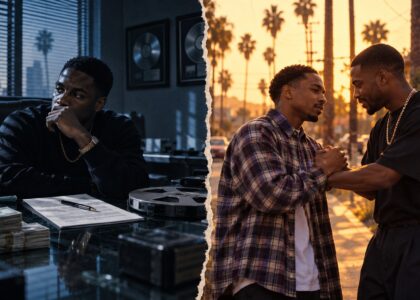
Movement-era style references the political organizing of the 1960s, from civil rights marches to the Black Panther Party’s community programs. Its visual language comes from documentary photography: the 1964 window photograph of Malcolm X, the 1967 wicker-chair portrait of Huey P. Newton, the raised fists of the 1968 Olympics. In clothing, it means bold type, archival imagery and graphic-novel framing.
Shop the three aesthetics
-
 They Fear What You Remember – Cosmic Graphic Crop Top$27.50Compare
-
 Hue-Man Project Tee – Afrofuturism Graphic T-ShirtPrice range: $25.50 through $30.00Compare
-
 High Frequency Tee – Lightning Bolt Streetwear T-ShirtPrice range: $24.00 through $27.00Compare
-
 Resistance The Movement Tee – Civil Rights Graphic T-ShirtPrice range: $23.00 through $45.00Compare
One tee per lane: Hue-Man Project for Afrofuturism, High Frequency for retro soul and Resistance The Movement for movement era. See the full collection.
Culture timeline: the references behind the designs
| Year | Moment | Aesthetic |
|---|---|---|
| 1913 | Federal Reserve Act signed | Money & the system |
| 1964 | Malcolm X window photograph | Movement era |
| 1966 | Black Panther Party founded in Oakland | Movement era |
| 1968 | Raised fists at the Mexico City Olympics; “Say It Loud” released | Movement era |
| 1969 | Free Breakfast for Children program launched | Movement era |
| 1971 | Soul Train begins taping in Los Angeles | Retro soul |
| 1974 | Space Is the Place released | Afrofuturism |
| 1975 | Parliament’s Mothership Connection | Afrofuturism / retro soul |
| 1993 | Parable of the Sower published; “Afrofuturism” coined | Afrofuturism |
| 2015 | To Pimp a Butterfly released | All three |
How to wear each aesthetic
| Aesthetic | Pair with | Avoid |
|---|---|---|
| Afrofuturism | Black denim, chunky sneakers, silver jewelry | Busy patterns that fight the graphic |
| Retro soul | Flares or wide-leg trousers, gold jewelry | Overly technical outerwear |
| Movement era | Leather jacket, beret, dark denim, boots | Costume-level styling; let the shirt lead |
Frequently asked questions
What is the difference between Afrofuturism and retro soul style?
Afrofuturism looks to the future through science fiction, space and technology, while retro soul looks back to the music, fashion and glamour of the 1970s.
Who coined the term Afrofuturism?
Cultural critic Mark Dery coined the term Afrofuturism in 1993, though artists like Sun Ra had been creating Afrofuturist work since the 1950s.
What is movement-era style in fashion?
Movement-era style references 1960s political organizing through documentary photography, bold typography and archival imagery, often in graphic tees.
Which culture aesthetic is best for a first graphic tee?
Movement-era designs are the most recognizable and easiest to explain, while Afrofuturist designs offer the most visual impact.
What are examples of Afrofuturism in movies?
Well-known examples include Space Is the Place (1974) starring Sun Ra, Black Panther (2018), and Janelle Monáe’s visual album Dirty Computer (2018).
What music is considered Afrofuturist?
Core Afrofuturist music includes Sun Ra, Parliament-Funkadelic, Alice Coltrane’s spiritual jazz, Janelle Monáe and Flying Lotus, all of which pair sound with cosmic or futuristic themes.
What does Sankofa mean?
Sankofa is an Akan word from Ghana usually translated as “go back and get it.” It is often shown as a bird looking backward while carrying an egg, meaning the past is a tool for building the future.
What does the raised fist symbol mean?
The raised fist stands for solidarity, pride and resistance. It became globally recognized after sprinters Tommie Smith and John Carlos raised their fists on the podium at the 1968 Mexico City Olympics.
How do you wear 1970s soul style today?
Pair one vintage-feeling piece, such as a retro graphic tee or wide-leg trousers, with modern basics, then add warm tones and gold jewelry. One statement piece reads as style; head-to-toe reads as costume.
How do I contact Infinite Life Lived customer support?
Email info@infinitelifelived.com for help with orders, sizing, shipping or returns. Include your order number if you have one.